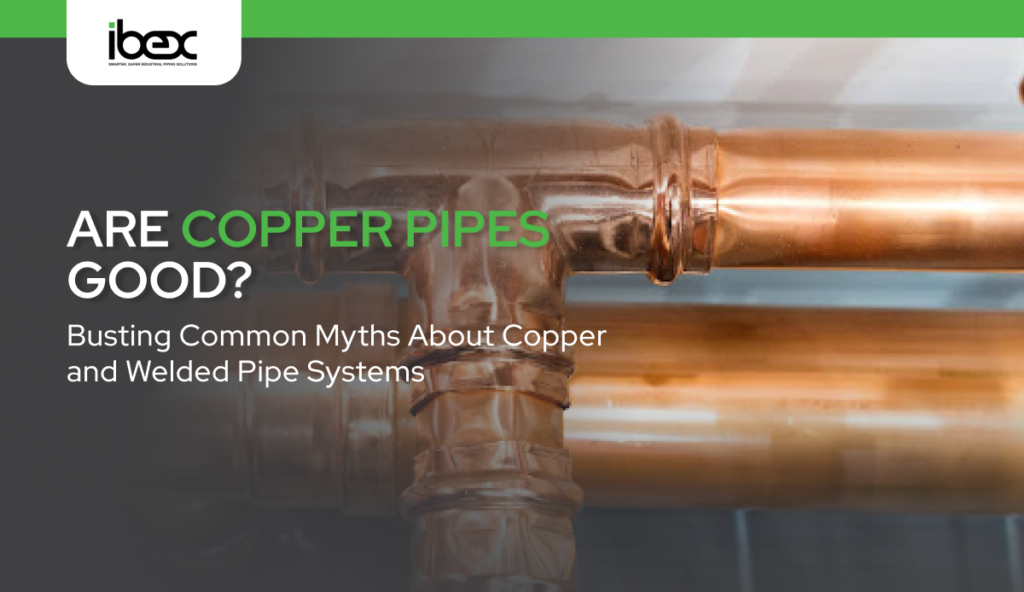
- Copper has earned its place in Australian plumbing over the past century. It’s durable, heat-resistant and familiar to installers across the country.
- But the question “are copper pipes good?” deserves a more nuanced answer than most people give it. The right material depends on the project, the environment and the total cost over the system’s life.
- Copper is vulnerable to pitting corrosion, particularly in Australian water conditions. The CSIRO has documented failures where one building is affected while neighbours are not.
- Stainless steel press-fit systems offer superior corrosion resistance, faster installation (up to 78% faster than welding, per BSRIA independent testing) and a service life exceeding 50 years.
- Press-fit technology eliminates hot works, fire watches and the need for scarce certified welders in a market projected to be short 70,000 welders by 2030.
- The total installed cost of a stainless steel press-fit system is comparable to or lower than copper and welded alternatives once labour, risk and lifecycle maintenance are factored in.
- Both materials have their place. The goal isn’t to replace copper everywhere. It’s to make sure you’re choosing the right system for the job.
Copper piping has been part of Australian construction for over a century. If you’ve worked on a residential, commercial or industrial project in this country, you’ve almost certainly specified, installed or maintained copper systems. So are copper pipes good? The short answer is yes, in the right conditions. But that answer comes with more caveats than most people realise.
The longer answer involves understanding how water chemistry, installation methods, project scale and total cost of ownership have shifted the calculation for modern commercial and industrial builds. Materials and joining methods have moved on. Projects that once defaulted to copper and welded joints now have access to stainless steel press-fit systems that deliver real advantages in speed, safety, corrosion resistance and lifecycle performance.
What follows is a straight look at what makes copper popular, where it performs well, how it compares to stainless steel on the factors that actually determine project outcomes, and why seven common assumptions about copper and welded pipe systems fall apart under scrutiny.
Seven Common Myths About Copper and Welded Pipe Systems
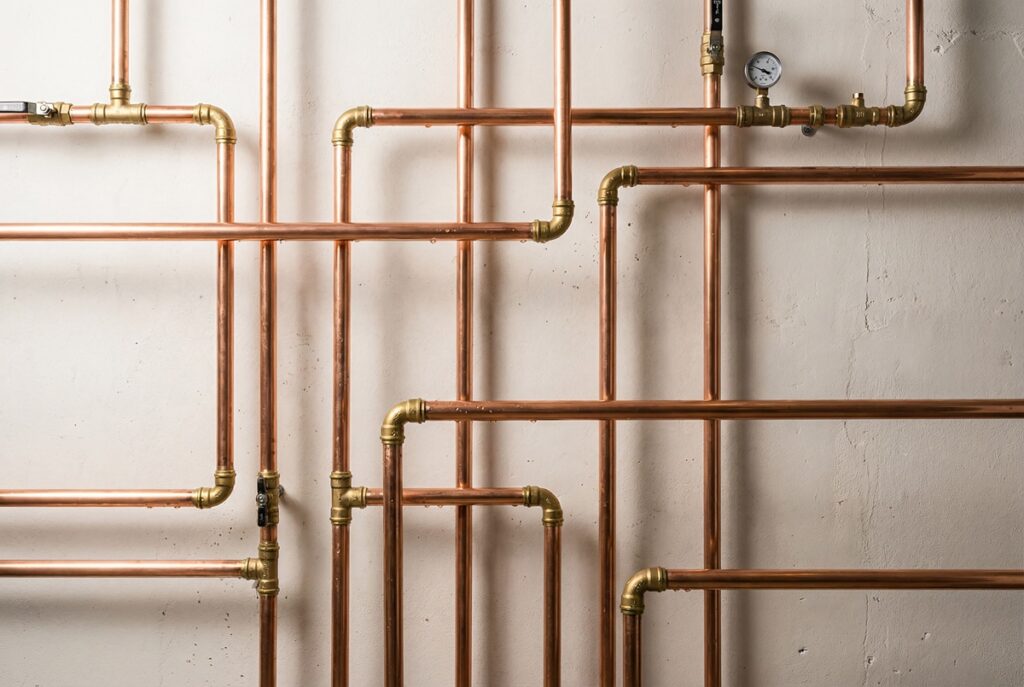
Myth 1: Welded Copper Joints Are Stronger Than Press-Fit Joints
Weld and braze quality varies with the person holding the torch. Over-heating weakens the copper tube wall. Under-heating leaves incomplete joints. Across a large commercial project with dozens of installers working different shifts, joint strength becomes inconsistent. That inconsistency is the risk.
Stainless steel press-fit joints are machine-calibrated. The crimping tool applies a pre-set force every time, compressing the fitting’s sealing element and deforming the fitting body and tube wall together to create both the seal and the mechanical interlock. Press-fit systems are pressure-tested and certified under AS 3688:2016 for operating pressures up to 1.4 MPa at 95°C. Joint strength doesn’t depend on who’s holding the tool or what time of day it is. On any project with more than a handful of joints, that consistency matters.
Myth 2: Copper Handles Expansion and Contraction Better
People confuse copper’s flexibility with superior thermal stability. The numbers don’t back it up. Copper’s coefficient of thermal expansion (~16.6 × 10⁻⁶/°C) is marginally higher than 316 stainless steel (~16.0 × 10⁻⁶/°C). Both materials need proper allowance for thermal movement in long pipe runs. Both handle it well when installed correctly.
Where stainless steel actually outperforms copper on thermal behaviour is heat retention. Because stainless steel conducts roughly one twenty-fifth the heat of copper, hot water stays hotter for longer inside the pipe. Less energy waste, less insulation cost, better performance in hot water recirculation systems. ASSDA confirms this thermal advantage as a practical benefit for Australian building services.
Myth 3: Press-Fit Joints Leak More Than Welded Copper
The opposite is closer to the truth. Quality press-fit systems include a built-in leak path indicator. If a fitting is accidentally left unpressed, the O-ring allows fluid to bypass during commissioning pressure testing, producing an obvious visible leak. Unpressed fittings get caught before the system is concealed behind walls or ceilings.
Welded and brazed copper joints don’t offer that safety net. A joint that passes initial testing can fail months or years later due to incomplete penetration, flux residue or heat-affected zone corrosion. Copper’s susceptibility to pinhole leaks from pitting corrosion adds long-term risk that press-fit stainless steel simply doesn’t carry. The Australian Drinking Water Guidelines (NHMRC) note that copper concentrations in stagnant pipe sections can reach 5 mg/L or higher, well above the 2 mg/L health guideline, indicating ongoing corrosion activity inside the system even when no visible leak exists.
Myth 4: Copper Is More Corrosion Resistant Than Stainless Steel
Copper resists corrosion in many environments. It’s far from immune to it. Pitting corrosion produces the pinhole leaks that represent one of the most common copper pipe failures worldwide. A 30-year peer-reviewed study published in AWWA Water Science documented the scale of the problem, and the CSIRO has investigated Australian-specific failures where copper corrodes unpredictably based on local water chemistry.
Blue water contamination from dissolved copper salts has been documented on Australia’s eastern seaboard since the 1970s. Chloraminated water supplies are particularly aggressive to copper, with over 5,000 pinhole leaks reported after a chloramine switch in a single US region. Active Plumbing, an Australian service provider, states there is no guaranteed remedial treatment for copper pipe corrosion other than replacing the affected section.
316L stainless steel forms a chromium oxide passive layer that self-repairs when scratched or damaged. It resists the chlorination levels used across Australian water treatment, handles coastal and marine environments that would pit copper, and performs reliably in the aggressive washdown conditions found in food processing, brewing and pharmaceutical facilities.
Myth 5: Welding Is the Most Reliable Traditional Joining Method
Welding can produce strong joints. But real-world reliability depends on consistent access to highly skilled tradespeople, and Australia’s welder shortage is well documented. Jobs and Skills Australia rates welders as a shortage occupation across all eight states and territories. Weld Australia warns of a 70,000-welder shortfall by 2030.
Then there’s the safety picture. In 2017, the International Agency for Research on Cancer (IARC) reclassified welding fumes as a Group 1 carcinogen, placing them alongside asbestos and tobacco smoke. In January 2024, Safe Work Australia reduced the Workplace Exposure Standard for welding fumes from 5 mg/m³ to 1 mg/m³. Hot work permits under AS 1674.1 require 15-metre clearance of combustible materials, atmospheric monitoring and post-weld fire watch.
Press-fit joining eliminates every one of those constraints. No fumes, no fire risk, no permits, no post-work fire watch. The joint takes seconds instead of minutes. And because the force is machine-applied, quality doesn’t vary with fatigue, lighting conditions or shift changes.
Myth 6: Press-Fit Systems Are Only for Temporary or Low-Pressure Applications
This myth falls apart fast once you look at what’s actually being built.
The Aurora in Brisbane, a 69-level residential tower, specified 316 stainless steel press-fit to withstand head pressure of 2,490 kPa. The system is rated to a working pressure of 2,600 kPa and a test pressure of 4,000 kPa. Sydney Tower replaced corroded carbon steel fire, potable water and gas lines with 300 metres of 316L stainless steel. Both projects are documented by the Australian Stainless Steel Development Association (ASSDA). The Maitland Hospital project in NSW used 15 km of press-fit stainless steel across the entire facility. You can explore more Australian project case studies to see the range of applications where press-fit is now specified.
Press-fit stainless steel is certified for water, gas, fire protection and industrial pressure piping under Australian Standards. It’s designed for permanent installation with a service life exceeding 50 years. Hospitals, data centres, high-rise residential towers and food processing plants rely on it daily.
Myth 7: Copper Is Always Cheaper Than Stainless Steel
Copper tube can be cheaper per metre at small diameters. At 15mm, the material cost difference is roughly 10% in copper’s favour. But that comparison ignores almost everything that determines the final cost of an installed piping system.
Above 28mm, stainless steel press-fit tubing is already 19–24% less expensive than copper on material cost alone. Factor in the 78% reduction in installation time (per BSRIA testing), the elimination of hot work permits, the broader pool of installers who can perform the work, the lower bracketing requirements and the reduced risk of corrosion-related maintenance over the system’s life, and stainless steel press-fit delivers a lower total installed cost on the majority of commercial and industrial projects.
Theft risk widens the gap further. Bare bright copper fetches AUD $10 to $12 per kilogram in Australian scrap markets. Stainless steel has negligible resale value to thieves. On large projects with exposed pipework during construction, the insurance and security costs alone can shift the equation.
What Makes Copper Pipes Popular
Copper earned its reputation. That deserves to be said upfront.
The material handles temperatures up to 200°C, has natural antimicrobial properties, resists corrosion across a wide pH range and carries a theoretical service life of 50 to 80 years under favourable conditions. MM Kembla has manufactured copper tube at Port Kembla, NSW since 1916, and their products still comply with AS 1432-2004 (reconfirmed 2016), the primary Australian standard for seamless copper tubes in plumbing, gasfitting and drainage.
Familiarity among installers is another genuine strength. Generations of Australian plumbers trained on copper brazing and soldering. The material is widely stocked, tooling is readily available and the installation techniques are well understood. For smaller residential jobs and certain heritage or retrofit applications, copper still makes practical sense.
Regulatory support also played a role. AS/NZS 3500 (the National Plumbing Code) has referenced copper as an accepted piping material for decades, and certain building codes still mandate copper in specific situations. At least one metre of copper pipework is required from hot water services before plastic connections in most Australian jurisdictions.
None of that is disappearing overnight. But the industry around copper is changing. PEX has captured an estimated 70% of the Australian residential hot and cold water supply market over the past 15 years. Stainless steel press-fit systems are steadily displacing copper in commercial, industrial and infrastructure applications. The question isn’t whether copper is a bad material. It’s whether it’s still the best material for the job you’re pricing right now.
Are Copper Pipes Still the Right Choice for Every Project
When people ask “are copper pipes good?” they’re actually asking two separate questions. Does the material perform? And does it perform better than the alternatives at a comparable or lower total cost? The answer to the first is still yes in many scenarios. The answer to the second is increasingly no for commercial and industrial work.
Copper commodity prices have risen more than 300% since 2008 and traded at US$5.73 per pound as of early 2026. That volatility makes project budgeting unreliable. Above 28mm pipe diameter, stainless steel press-fit is already 19–24% less expensive than copper on material cost alone, before factoring in the labour and risk savings that come with mechanical joining.
Copper theft has become a serious operational concern on Australian sites. In May 2024, three contractors in Sydney were charged with stealing over $3.5 million worth of copper from infrastructure sites. Queensland copper theft on construction sites has reportedly tripled since 2020. Bellrock Advisory warns that insurers apply high excesses and special conditions for copper-rich sites, adding hidden costs to projects that don’t appear on a material takeoff. These risks sit alongside ongoing price volatility can be explored further in our article What is the market price for copper? and Why rising copper costs are driving a switch to stainless steel.
The welder and brazer shortage compounds the problem further. Weld Australia projects a shortfall of at least 70,000 skilled welders by 2030. Experienced copper brazers are part of that shortage. Press-fit stainless steel installation can be performed by licensed plumbers and supervised pipefitters using battery-powered crimping tools, broadening the available labour pool significantly.
For small-bore residential work, heritage repairs and specific code-mandated applications, copper remains a practical choice. For new commercial builds, hospitals, food processing facilities, mining infrastructure and multi-storey developments, the data increasingly favours stainless steel press-fit systems on performance, cost and risk.
Copper vs Stainless Steel Key Differences
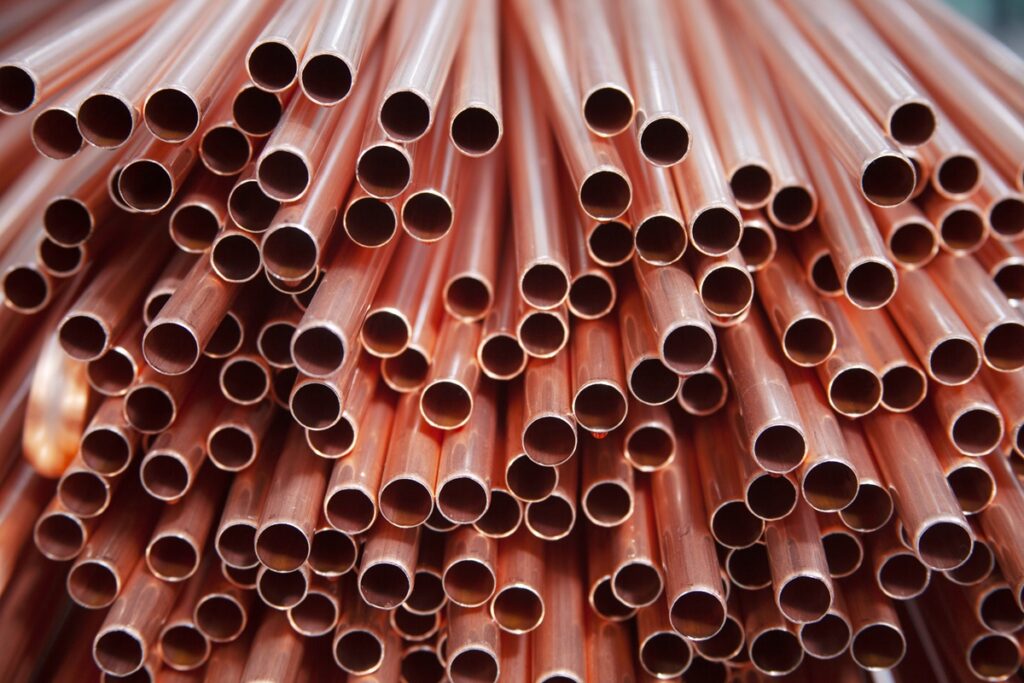
Material Durability
Copper’s theoretical lifespan is 50 to 80 years, though thin-wall copper can fail in as little as 20 years depending on water chemistry and soil conditions. Stainless steel delivers 50 to over 100 years of service life, with 2.5 times the tensile strength and 40% greater rigidity than copper. That strength advantage means stainless steel piping requires up to 40% less bracketing and support, reducing installation time and material costs for fixings.
Corrosion Resistance
Copper performs well in many water conditions, but it’s vulnerable to pitting corrosion. This produces the pinhole leaks that are one of the most common and expensive copper pipe failures. The CSIRO has documented copper corrosion failures across Australia, and the Australasian Corrosion Association identifies blue water, pitting corrosion and erosion corrosion as persistent issues in Australian water supplies. Underground copper in contact with certain soils can fail in as little as two to three years.
Stainless steel (316L) forms a self-repairing chromium oxide passive layer that provides strong resistance to pitting, chloride attack and the chlorinated water conditions common across Australian municipal supplies. Grade 316L handles water velocities up to 6 m/s, triple copper’s recommended limit of 2 m/s.
Thermal Expansion
This is closer than many people expect. Copper’s coefficient of thermal expansion is approximately 16.6 × 10⁻⁶/°C, while 316 stainless steel sits at approximately 16.0 × 10⁻⁶/°C. The difference is negligible in most practical applications. Where stainless steel gains a real advantage is thermal conductivity. At just 15 W/m°C compared to copper’s 385 W/m°C, stainless steel loses roughly one twenty-fifth the heat through pipe walls. That reduces insulation requirements and energy costs over the system’s life.
Installation Methods
Copper brazing requires open flame, hot work permits under AS 1674.1, fire watch personnel and completely dry pipes. A typical soldered copper joint takes three to five minutes. Stainless steel press-fit systems complete joints in 15 seconds to one minute using battery-powered crimping tools. No flame, no fumes, no permits, no fire watch. An independent BSRIA time-and-motion study found press fit was 78% faster than welding for identical assemblies. For a detailed breakdown of mechanical joining methods, we’ve published a separate guide on how to join pipes without welding.
Lifecycle Costs
Copper may appear cheaper on a per-metre basis at smaller diameters, but the total installed cost tells a different story. A food processing plant cost projection over 20 years showed copper maintenance and replacement costs eclipsed initial material savings within seven years. The Maitland Hospital project in NSW installed 15 km of 316L stainless steel press-fit tubing and achieved installation speeds 10 times faster than conventional welding, reducing overall project costs by approximately 30%.
Comparison at a Glance
| Factor | Copper | Stainless Steel Press Fit |
| Typical service life | 50–80 years (variable) | 50–100+ years |
| Corrosion resistance | Vulnerable to pitting in certain water conditions | Self-repairing chromium oxide layer; resists chlorides |
| Thermal expansion coefficient | ~16.6 × 10⁻⁶/°C | ~16.0 × 10⁻⁶/°C |
| Maximum water velocity | ~2 m/s | ~6 m/s |
| Installation speed (per joint) | 3–5 minutes (soldering) | 15 seconds – 1 minute (press fit) |
| Hot works required | Yes (brazing/soldering) | No |
| Theft risk | High (scrap value AUD $10–$12/kg) | Negligible |
| WaterMark-approved for potable water | Yes | Yes (316L with EPDM O-ring) |
How Ibex Australia Supports Your Next Project
At Ibex Australia, we supply a full range of 316L stainless steel press-fit systems built for the applications where copper and welded systems are increasingly being reconsidered:
- Tubepress is our German high-pressure press-fit range for demanding industrial applications.
- Impress is engineered for high-performance, size range 15mm to 168mm for larger bore industrial systems where durability and corrosion resistance are critical. Commercial and Industrial piping across water, gas, fire and HVAC applications.
Every product is Watermark-approved for potable water applications and backed by full traceability documentation. But products are only part of what we offer.
We work alongside engineers, contractors and procurement managers from specification through to installation and after-sales support. That means dedicated account managers who answer the phone, technical advice on material selection and compliance, tooling hire and loan options for crimping equipment, on-site training for your installation team and honest communication on stock levels and lead times. If you’re comparing copper vs stainless steel for your next project, our technical team can help you assess both options against your specific project requirements.
Whether you’re specifying stainless steel press fit for the first time or transitioning from copper across your project portfolio, we’re here to help you make that decision with the right information and the right support behind it.
Choose Your Next Piping System With Confidence
Are copper pipes good? They can be. In the right conditions, at the right scale, for the right application, copper still has a role. But the assumptions that made copper the automatic choice for Australian commercial and industrial projects don’t hold up the way they once did.
Corrosion risks are real and documented. The welder shortage is accelerating. Copper prices are volatile. Stainless steel press-fit systems now match or exceed copper’s performance on every metric that matters, while delivering faster installation, lower lifecycle costs and zero hot works risk.
Talk to our team about the right system for your next project. Call 1300 85 45 20, email sales@ibexaustralia.com.au or get in touch through our website.
Frequently Asked Questions
- Are Copper Pipes Good for Potable Water in Australia?
Copper is approved for potable water under AS/NZS 3500 and has been used for decades. However, the Australian Drinking Water Guidelines (NHMRC) set a health-based limit of 2 mg/L for copper in drinking water, and stagnant conditions in copper pipes can produce concentrations of 5 mg/L or higher. 316L stainless steel with EPDM O-rings is also Watermark-approved for potable water and doesn’t leach metals into the water supply under normal conditions.
- How Long Do Copper Pipes Last in Australia?
Copper pipe lifespan varies significantly depending on water chemistry, soil conditions and installation quality. The typical range is 50 to 80 years, though thin-wall copper and installations in aggressive water conditions can fail much sooner. Pitting corrosion remains the primary risk, and the CSIRO notes that failures can be unpredictable. Stainless steel press-fit systems are designed for 50 to 100+ years of service life.
- Is Stainless Steel Press Fit Cheaper Than Copper?
Above 28mm pipe diameter, stainless steel press-fit is 19–24% less expensive than copper on material cost. At smaller diameters, copper can be marginally cheaper per metre. However, when you account for the reduction in labour time (up to 78% faster installation per BSRIA data), the elimination of hot works and the lower ongoing maintenance costs, stainless steel press-fit delivers a lower total installed cost on most commercial and industrial projects.
- Do You Need Specialist Qualifications to Install Press-Fit Systems?
No formal welding or brazing certification is required. Press-fit installation can be performed by licensed plumbers, supervised pipefitters and plumbing apprentices using the correct pressing tool and jaw profile. Proper training on tool use, insertion depth marking and O-ring inspection is important, and it’s something we provide through on-site sessions.
- Are Copper Pipes Good for Large Commercial Projects?
Copper can work in commercial applications, but the cost, corrosion and installation challenges become more pronounced at scale. Large projects like the Maitland Hospital (15 km of press-fit stainless steel), The Aurora Brisbane (69 levels) and Sydney Tower (300 metres of 316L replacement piping) have moved to stainless steel press-fit for performance, speed and lifecycle cost reasons. For most new large-scale commercial builds, stainless steel press-fit is the stronger option.